Jagannath Temple Alwar, Purana Katla
The 260-year-old temple at Subhash Chowk where Lord Jagannath resides with Mata Janaki, and rides the royal Indra Viman every Ashadha in a Rath Yatra that is celebrated as his grand wedding.
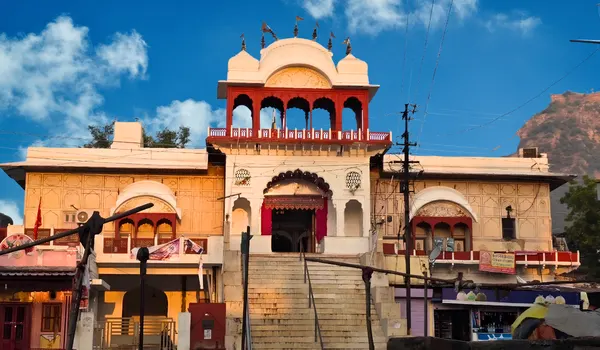
Jagannath Temple Alwar (जगन्नाथ मंदिर अलवर) stands in the heart of the old city at Purana Katla, Subhash Chowk, and has been the emotional centre of Alwar for more than 260 years. Perched about 60 feet above street level, this temple of Lord Jagannath (भगवान जगन्नाथ) is unlike any other Jagannath temple in India. Its garbhagriha holds not one but two idols of the presiding Lord, and here Lord Jagannath resides with Mata Janaki (माता जानकी), not with Balabhadra and Subhadra as in Puri.
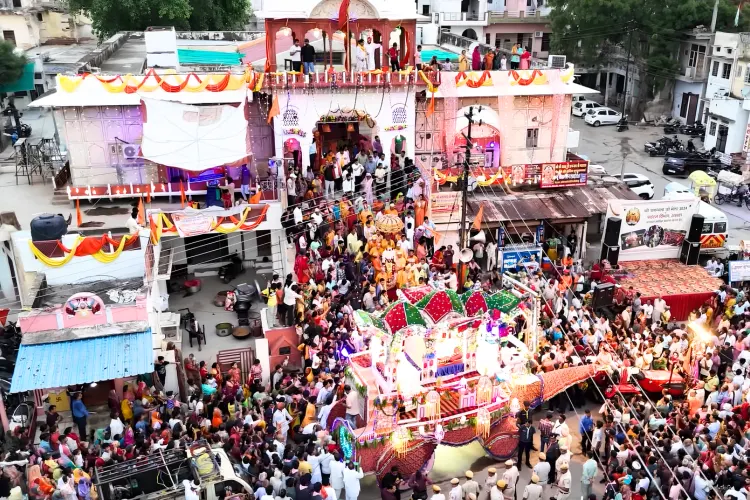
Every year in the month of Ashadha, the temple hosts a Rath Yatra that is actually a grand wedding. Lord Jagannath, as a form of Lord Vishnu, travels in the historic Indra Viman chariot to Roopbas to wed Mata Janaki, a tradition Alwar has celebrated for over 165 years.
This guide covers everything a devotee or visitor needs: the temple’s history and mahant lineage, the story of the two idols and Budhe Jagannath Ji, the complete Rath Yatra and Vivah Utsav sequence, six daily aartis with bhog, darshan tips, how to reach, and nearby temples of Alwar.
Everything Covered in This Guide
Navigate to any section — the sacred story, the two idols, the famous Rath Yatra and Vivah Utsav, timings, or travel tips — all in one comprehensive guide.
Temple at a Glance
The Sacred Story of Bhagwan Jagannath Ji
History of Jagannath Temple Alwar
Why Two Idols of Lord Jagannath
Temple Architecture & Complex
Famous Rath Yatra & Vivah Utsav
Kangan Dore & Mannat Traditions
Darshan & Aarti Timings
Best Time to Visit
Festival Celebrations & Calendar
How to Reach
Pilgrim Essentials, Accessibility & Tips
Nearby Temples & Places to Visit
FAQs
Jagannath Temple Alwar – at a Glance
Temple at a Glance
Complete quick-reference information about Jagannath Temple (Jagannath Mandir), Alwar — for devotees, researchers, and travellers.
| Temple Identity | ||
| 🏷️ | Official Name | Shri Jagannath Ji Temple, Alwar (श्री जगन्नाथ जी मंदिर, अलवर) |
| 📝 | Also Known As | Jagannath Mandir Alwar Jagannath Ji Ka Mandir Purana Katla Temple |
| 📍 | Location | Purana Katla, Subhash Chowk, Old City, Alwar, Rajasthan |
| Deity & Worship | ||
| 🙏 | Presiding Deity | Lord Jagannath (भगवान जगन्नाथ) — worshipped as a form of Lord Vishnu, with Mata Janaki (माता जानकी) and Sitaram Ji |
| ✨ | Unique Feature | Two idols of Lord Jagannath Budhe Jagannath Ji darshan only 5 days a year |
| History & Architecture | ||
| 📅 | Origin | Over 260 years old, per temple tradition — Rath Yatra tradition running for more than 165 years |
| 🏛️ | Temple Setting | Elevated temple, about 60 feet above street level |
| 🔖 | Maintained By | Hereditary Mahant family, serving for six to seven generations |
| How to Reach — Distances | ||
| 🚆 | Nearest Railway | Alwar Junction — approx. 3 km from the temple |
| 🚗 | From Jaipur / Delhi | ~160 km by road from each city — approx. 2 to 2.5 hr by train on the Delhi–Jaipur line |
| ✈️ | Nearest Airport | Jaipur International Airport — approx. 160 km |
| Visitor Information | ||
| 🕰️ | Daily Worship | Six aartis daily Mangla Aarti ~5:15 AM · Sandhya Aarti 7:30 PM |
| 🎟️ | Entry Fee | Free Entry |
| 🎉 | Main Festival | Rath Yatra & Vivah Utsav — Ashadha Shukla Navami to Trayodashi |
The Sacred Story of Bhagwan Jagannath ji
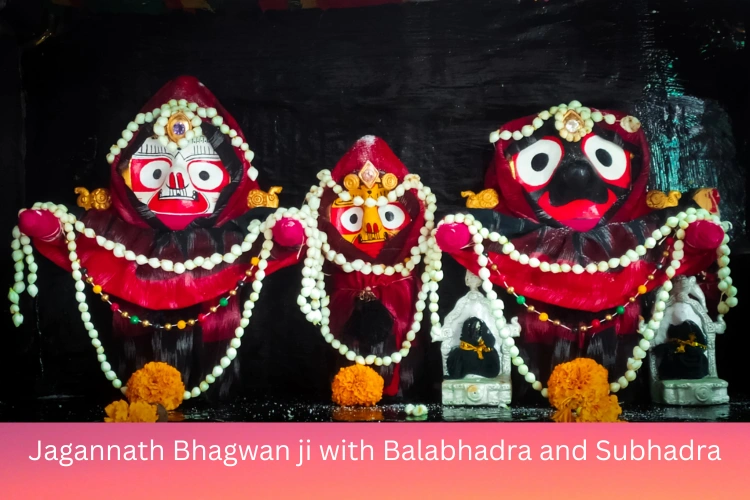
Bhagwan Jagannath (भगवान जगन्नाथ) is revered across India as a form of Bhagwan Vishnu Ji (विष्णु भगवान), and his very name means Lord of the Universe. Devotees see in him the same divine love that Lord Krishna showered on his devotees, now seated in a form that watches over all beings with large, ever-open eyes.
Sacred tradition tells of a moment in Dwarka when Mata Yashoda, Devaki Ji, and Subhadra Ji began narrating the childhood leelas of Shri Krishna to the queens of the palace. Subhadra Ji stood at the door to keep watch, but she too became so absorbed in the stories that she did not notice Shri Krishna and Balram Ji arrive and listen. Hearing their own leelas, the brothers were filled with such bliss that their eyes grew wide, their smiles spread, and their forms began to melt in the warmth of pure bhakti.
Subhadra Ji, the most deeply moved of all, melted the most, which is why her form is the smallest among the three. When Narad Muni arrived and saw this enchanting form, he prayed to Shri Krishna to appear in it for the world. The Lord promised he would, in Kalyug, through King Indradyumna.
Devotees further cherish the story of how that promise was fulfilled. Lord Vishnu appeared in King Indradyumna’s dream and asked him to carve his idol from sacred wood washed ashore on the coast of Puri. Vishwakarma Ji himself came in the form of an aged carpenter and agreed to craft the idols on one condition, that no one would watch him at work. When the king’s patience gave way and he peeked inside, the divine carpenter left the work as it was.
The idols of Lord Jagannath, Balabhadra Ji, and Subhadra Ji thus remained without hands and feet, and devotees believe the heart of Shri Krishna resides within Lord Jagannath’s form to this day, his wide eyes forever open so that no devotee is ever out of his sight.
These beloved forms grace the great temple of Puri, from where the Jagannath tradition spread across the country. The temple of Alwar, however, carries this tradition forward in its own remarkable way. Here Lord Jagannath does not reside with Balabhadra Ji and Subhadra Ji, but with Mata Janaki (माता जानकी), and that difference is the heart of everything that follows.
History of Jagannath Temple Alwar
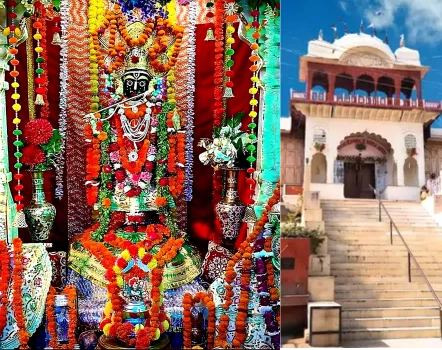
Temple tradition holds that Jagannath Temple Alwar was established more than 260 years ago, in the era when Alwar was taking shape as a princely state. The temple was built, according to the mahant family, by their own ancestors, and the same lineage has served Lord Jagannath (भगवान जगन्नाथ) here for six to seven unbroken generations.
The present mahants grew up hearing from their elders how each generation before them woke the Lord for Mangla Aarti, prepared his bhog, and carried the responsibility of his annual wedding procession.
This living continuity is itself the temple’s most precious historical record. Very few temples in Rajasthan can trace a single family of caretakers across so many generations, and it is this unbroken seva that has kept the temple’s traditions, from the six daily aartis to the Rath Yatra rituals, intact in their original form.
The temple rises about 60 feet above the lanes of Purana Katla at Subhash Chowk, in the oldest quarter of Alwar city. Its elevated position, the 26 steps to the entrance, and the frescoes still visible in the rooftop chhatris all speak of the same early period of construction that temple tradition describes.
The documented royal connection of the temple centres on its celebrated chariot, the Indra Viman. This grand carriage originally belonged to the erstwhile Maharajas of Alwar, who used it as a royal conveyance drawn by elephants. The rulers of Alwar held deep faith in Lord Jagannath, and the royal household maintained elephants specifically so that the Lord’s chariot could be pulled through the city during the Rath Yatra. In time, the royal family donated the Indra Viman to the temple permanently, and it has carried Lord Jagannath to his wedding at Roopbas ever since. In earlier days the Maharaja himself would come to the temple to perform the pujan that set the Rath Yatra in motion. After the princely era ended, that honour passed to the district administration, and today the District Collector, Superintendent of Police, and other senior officials perform the rath pujan before the procession departs.
The Rath Yatra and Vivah Utsav tradition itself has run for more than 165 years without interruption. The elephants of the royal stables are gone, and a tractor now draws the Indra Viman through the same streets, but everything else remains as the mahant family received it: the same tithis, the same route lined with temples offering aarti, and the same wedding of Lord Jagannath and Mata Janaki (माता जानकी) that Alwar has celebrated since the days of its kings.
Why Two Idols of Lord Jagannath – Jagannath Temple Alwar
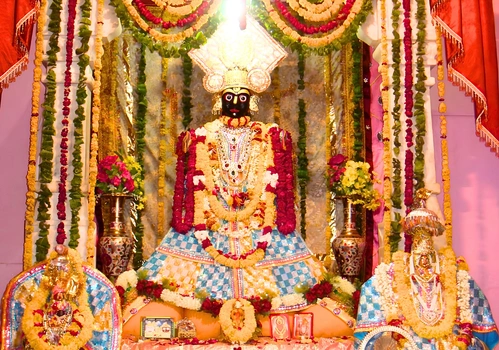 Bhagwan Jagannath, Jagannath Temple Alwar
Why Two Idols of Lord Jagannath
Jagannath Temple Alwar holds a distinction that devotees believe exists nowhere else: two idols of the same presiding Lord reside here together. The first is the chal pratima, a movable wooden idol of Lord Jagannath (भगवान जगन्नाथ) that receives daily worship and travels in the Indra Viman during the Rath Yatra. The second is the achal pratima, the fixed idol lovingly known as Budhe Jagannath Ji (बूढ़े जगन्नाथ जी), which remains forever seated within the temple. Temple tradition holds that the Lord’s sinhasan must never fall empty. So when the chal pratima departs for Roopbas to wed Mata Janaki (माता जानकी), the darshan of Budhe Jagannath Ji opens for devotees, and for only those five days in the entire year.
These five days draw a sea of devotees from Alwar and far beyond, for many consider even a single darshan of Budhe Jagannath Ji the blessing of a lifetime. The moment Lord Jagannath returns with his bride, the rare darshan closes until the next Ashadha.
Temple Architecture and Complex of Jagannath Temple Alwar
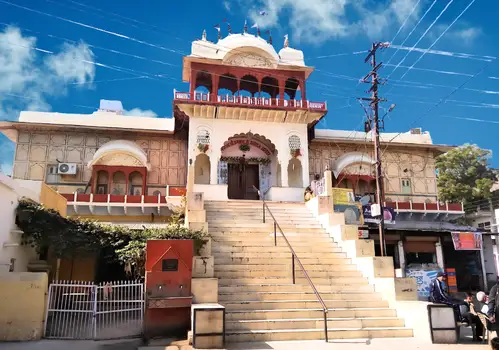
The first thing you notice about Jagannath Temple Alwar is that you can take darshan without climbing a single step. The temple sits about 60 feet above the lanes of Purana Katla, and its entrance gate lines up exactly with the garbhagriha, so a person standing on the road below looks straight up at Lord Jagannath (भगवान जगन्नाथ). Locals use this all the time.
Riders slow their bikes at Subhash Chowk, fold their hands, touch their forehead, and carry on. For everyone else, 26 steps lead up to the entrance, and the climb is worth it, because from the top the whole old city opens up around you.
Dohas and chaupais are painted along the walls near the entrance, verses about the path of life that devotees pause to read on their way in.
Inside, the temple follows the pattern of Alwar’s old havelis: rooms and galleries arranged around a large open courtyard, with a beda at the centre. A Tulsi plant grows in the courtyard, as it does in most Hindu homes. In the weeks before the mela the courtyard turns into a workshop.
Tailors sit stitching the poshak for the deities and the poshish, the fitted cloth that dresses the three chariots. The left wing of the complex has its own smaller temples, with sindoor-covered murtis of Hanuman Ji and Bhairon Baba, and Ganesh Ji beside them.
Near the garbhagriha, silver and gold coins offered by devotees over many years are still fixed in place, and marble plaques line the walls, donated by families from Behror, Bihar, even London, many with the samvat of their offering carved in.
The temple rasoi deserves its own mention. This is where women of the temple prepare Lord Jagannath’s bhog fresh every day, the same way a family cooks for its own members, and the kitchen is kept spotless for exactly that reason.
Climb the old stairs to the roof and the temple shows its age in the best way. The chhatris up there still carry their original frescoes, bhitti chitra of Lord Vishnu, Ganesh Ji, and a full darbar scene with vanars in attendance, painted when the temple was built and faded now but clearly readable. From the same roof you can see Bala Qila on its hill, the Aravali ridge behind it, Chaubhuja Hanuman Temple to one side, and the small Chhatangi Hanuman Temple on its distant peak. Few visitors ask to go up. The ones who do get the best view in old Alwar.
Famous Rath Yatra at Jagannath Temple Alwar and Vivah Utsav
 Rath Yatra, Jagannath Temple Alwar
The Famous Rath Yatra and Vivah Utsav
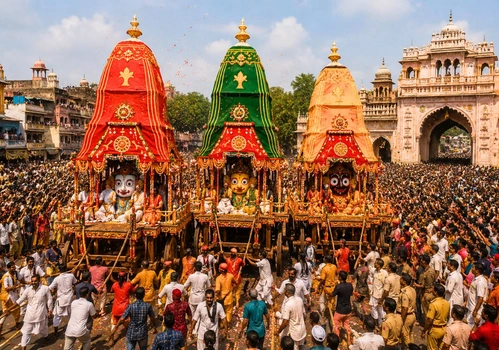
Every Ashadha, Alwar celebrates a wedding. Not a re-enactment and not a procession for its own sake, but a full baraat in which Lord Jagannath (भगवान जगन्नाथ), as the groom, travels through the old city to Roopbas to wed Mata Janaki (माता जानकी). Puri’s Rath Yatra carries the Lord with his brother and sister.
Alwar’s carries a dulha. This is the difference devotees here will explain to you first, and it is why the whole utsav unfolds like an Indian wedding, with a Ganesh Pujan to open it, mangal geet, a baraat, a varmala night, and a vidai. The tradition is more than 165 years old and is widely regarded in Rajasthan as the biggest Rath Yatra after Puri itself.
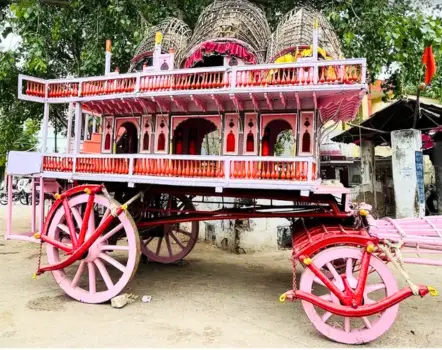
The groom rides the Indra Viman, the historic chariot of the erstwhile Maharajas of Alwar. Elephants from the royal stables once pulled it through the city. Today a tractor does the work, but the chariot itself is the same one the royal family donated to the temple generations ago.
Three chariots take part in all. Lord Jagannath’s Indra Viman waits at Mahal Chowk through the year, Mata Janaki’s rath stands in the Choodi Market, and Sitaram Ji’s rath rests in the temple courtyard itself. In the days before the mela, all three are repaired, dressed in fresh poshish, and made ready.
The utsav follows the same tithis every year. It opens with Ganesh Pujan, exactly as a family begins its own wedding, and invitation cards go out from the temple. On Dooj, Lord Jagannath is prepared as a groom: abhishek with milk, ghee, honey, and kevda, kangan dore tied on his wrist, tilak on his forehead. For several days after this the pats close and an akhand sankirtan of the Hare Ram dhun runs day and night inside the temple. Sitaram Ji’s rath leaves first for Roopbas. Then, on Ashadha Shukla Navami, the Indra Viman rolls out of Mahal Chowk with Lord Jagannath aboard, and Alwar pours into the streets.
The rath pujan that starts the yatra was once performed by the Maharaja himself. Today the District Collector, the Superintendent of Police, and other senior officials perform it, and the procession moves off with bands, jhankis, and lakhs of devotees walking behind.
The route runs through the heart of the old city, and close to a hundred temples fall along it. At each one, the deity’s caretakers wait with an aarti thali, and each temple considers it a matter of good fortune that Lord Jagannath is passing its door. Along the way, families set up stalls distributing fruit and food, and cold water piaus line the road for the baraatis. Two days later comes the bride’s turn. On the morning of her departure, Mata Janaki’s rath leaves Choodi Market for Roopbas with 1100 women walking ahead of it, each carrying a kalash, all in matching saris, singing mangal geet the entire way.
That night, Devshayani Ekadashi, is the varmala night. At the Roop Hari Mandir in Roopbas, around 10:30 PM, Lord Jagannath and Mata Janaki exchange varmalas before a crowd of lakhs, and the cry of Jai Jagannath, Jai Janaki Maiya carries across the town. Devotees offer many varmalas for the ceremony, including ones of silver and lotus and garlands sent from Vrindavan, and in recent years a devotee family settled in Dubai has been sending the Lord’s wedding poshak and itra.
A mela fills Roopbas the next day, and on Trayodashi evening Lord Jagannath returns to Alwar with his bride, completing the vidai in reverse. Back at the temple, these are also the only days of the year when the darshan of Budhe Jagannath Ji stays open, since the Lord’s sinhasan must never sit empty while he is away.
Two things about this utsav stay with everyone who has seen it. The first is the rain. Devotees firmly believe that the Rath Yatra never passes without rainfall, and many in Alwar say the city’s monsoon truly begins the day the Indra Viman rolls out. The second is who walks in the baraat: Hindu, Muslim, and Sikh residents of Alwar all join the procession, because after 165 years this wedding belongs to the whole city.
Kangan Dore and Mannat Traditions
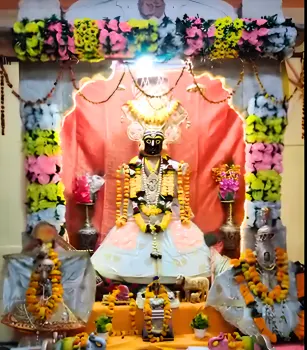
Because Lord Jagannath weds every single year, devotees believe this temple holds a special power over weddings that refuse to happen. The tradition works like this.
On Dooj, when kangan dore are tied on the Lord’s own wrist as part of his groom rituals, devotees whose marriages are delayed come and tie kangan dore too. The reasoning is simple and touching: if we share in the Lord’s wedding rituals, our own wedding will follow.
Families travel for this from well beyond Rajasthan, from UP, Bihar, Bengal, and Haryana, and the temple’s walls hold marble plaques from devotees settled as far away as London. Sit in the courtyard for an hour during the mela and you will hear the stories yourself.
A mother tying a nariyal for her daughter working in Canada. Another praying for her son’s new company abroad. Devotees say the results come quickly, some believe within three months.
The mannat nariyal is the other half of this tradition. Devotees tie a coconut at the temple for any wish, not only marriage, and the nariyals stay tied through the year, hundreds of them, each one a prayer left in the Lord’s keeping.
What happens to all those coconuts is the detail most visitors never learn. When the next mela arrives, the temple has every nariyal ceremonially opened by eleven pandits with mantra jaap, so that even a devotee who could not travel back has their mannat properly completed. Nobody’s prayer is left hanging.
Over the years the tradition has drawn everyone from ordinary households to well-known public figures and leaders, whose photographs of nariyal offerings hang in the temple gallery. But the truest measure of this tradition is local and everyday: people in Alwar treat Jagannath Ji as their isht dev, and before starting any shubh work, the standing advice in the city is the same as it has been for generations. Go to Jagannath Ji first, offer a dhok, then begin.
The mahant family keeps an open invitation on this count. You do not need to wait for the mela. Any month of the year, a devotee can climb the 26 steps, tie a nariyal, and leave their mannat with the Bhagwan ji.
Darshan and Aarti Timings – Jagannath Temple Alwar
Darshan, Six Aartis & Bhog
Complete aarti schedule and the seasonal bhog tradition of Jagannath Temple Alwar, as shared by the temple’s pandit family.
| Aarti / Bhog | Time | Bhog Offered |
|---|---|---|
| Mangla Aarti First aarti of the day | 5:15 AM | Makhan-mishri bhog |
| Bal Bhog Morning offering | 6:30 AM | Khichdi or chawal — following the saying “Jagannath ji ka bhaat, jagat pasare haath” |
| Rajbhog Midday thali | 11:00 AM | Full thali with many dishes, prepared as a family meal |
| Godhuli Bhog When evening pats open | Godhuli vela | Fruits; sharbat in the summer months |
| Sandhya Aarti Evening aarti | 7:30 PM | Khichdi — bajra khichdi in winter, dal-chawal khichdi otherwise |
| Shayan Aarti Night, before the Lord rests | Night | Milk daily; thandai, sharbat, or aam ras by season, with mishthan such as besan laddu |
| Darshan | Availability | Notes |
|---|---|---|
| Daily Darshan Open | All days | Free entry; parikrama of the garbhagriha is open to all devotees |
| Street Darshan Open | Anytime | The Lord is visible from the road below through the entrance gate — a rare feature of this temple |
| Budhe Jagannath Ji Darshan Rare | 5 days a year | Opens only during the Rath Yatra, while the Lord travels to Roopbas |
| Daily Prasad Khichdi tradition | Daily | Khichdi prasad is distributed at the temple every day |
Best Time to Visit Jagannath Temple Alwar
Best Time to Visit Jagannath Temple Alwar
Jagannath Temple sits in the heart of old Alwar at Purana Katla, barely 3 km from Alwar Junction, so reaching it is easy in any season. The real question is not access but experience: October to March offers the most comfortable darshan weather, while the Ashadha mela in June–July is when the temple becomes the centre of the entire city.
Pleasant weather for exploring the old city on foot, climbing the 26 steps comfortably, and combining darshan with nearby places like Bala Qila and the City Palace. Winter mornings during Mangla Aarti are especially peaceful, with bajra khichdi offered as the evening bhog in these months.
The Rath Yatra and Vivah Utsav transform old Alwar for nearly two weeks. This is also the only window for Budhe Jagannath Ji’s darshan. Expect lakhs of devotees on Rath Yatra day, and remember the devotees’ belief: the yatra never passes without rain, so keep an umbrella handy.
Alwar summers are harsh, and the old city lanes hold the heat. If you visit in these months, come for Mangla Aarti or after sunset for Sandhya Aarti at 7:30 PM, when the Lord’s seasonal bhog itself turns to sharbat, thandai, and aam ras.
On Rath Yatra Day, Reach the Old City Early
On Ashadha Shukla Navami, lakhs of devotees fill the narrow lanes of Purana Katla and vehicles cannot get close to the temple. Park well outside the old city and walk in, or take darshan along the procession route itself, since the Indra Viman passes close to a hundred temples on its way. Devotees often stay on the streets until well past midnight, so plan your return accordingly. Exact mela dates shift each year with the tithi, so confirm the current year’s schedule before travelling.
Festival Celebration and Calendar – Jagannath Temple Alwar
Festival Celebrations
Festival Celebrations at Jagannath Temple Alwar
The entire festival year of this temple revolves around one grand event: the wedding of Lord Jagannath (भगवान जगन्नाथ) and Mata Janaki (माता जानकी). The utsav follows the same tithis of Ashadha Shukla Paksha every year, unfolding step by step exactly like a family wedding.
| Occasion | When | What to Expect |
|---|---|---|
|
Ganesh Pujan
Utsav opening
|
Ashadha, before Dooj | The wedding season opens as it would in any household — Ganesh Ji is invited first, and invitation cards are distributed from the temple. |
|
Abhishek & Kangan Dore
Groom rituals begin
|
Dooj | Lord Jagannath receives abhishek with milk, ghee, honey, and kevda, and kangan dore are tied. Devotees seeking marriage tie their own kangan dore and mannat nariyals from this day. |
|
Akhand Sankirtan
Pats remain closed
|
3 days before the yatra | The Hare Ram dhun runs continuously inside the temple day and night while the Lord is prepared for his baraat. |
|
Rath Yatra
Ashadha Shukla Navami
|
June – July | The Indra Viman carries Lord Jagannath through the old city towards Roopbas. Lakhs walk in the baraat, close to a hundred temples on the route offer aarti, and Budhe Jagannath Ji’s rare darshan opens at the temple from this day. |
|
Mata Janaki’s Kalash Yatra
The bride departs
|
Morning of Ekadashi | Mata Janaki’s rath leaves Choodi Market for Roopbas with 1100 women in matching saris walking ahead, carrying kalash and singing mangal geet. |
|
Varmala Mahotsav
Devshayani Ekadashi
|
Around 10:30 PM | The wedding itself, at Roop Hari Mandir in Roopbas. Varmalas of silver, lotus, and garlands from Vrindavan are offered, and lakhs of devotees witness the ceremony. |
|
Roopbas Mela
Baras
|
Day after the wedding | A full day’s mela fills Roopbas while the newly-wed Lord remains with his bride’s town. |
|
Return with Mata Janaki
Trayodashi evening
|
Around 6:00 PM | Lord Jagannath returns to Alwar with Mata Janaki, completing the vidai. Budhe Jagannath Ji’s darshan closes as the Lord takes his sinhasan again. |
Five Days When Everything Rare Becomes Possible
The days between the Rath Yatra and the Lord’s return are the richest of the temple’s year. This is the only window for Budhe Jagannath Ji’s darshan, the only time the wedding rituals can be witnessed, and the season when devotees from across India and abroad tie their kangan dore. The same vivah tradition is also followed at temples in Rajgarh and Malakheda in Alwar district, but the Purana Katla temple remains the heart of it all.
How to Reach Jagannath Temple Alwar
How to Reach Jagannath Temple, Alwar
Jagannath Temple sits at Purana Katla, Subhash Chowk, in the heart of old Alwar city. This is one of the easiest temples in the district to reach: the bus stand is just 1.5 km away, the railway station 3.5 km, and no forest roads or long walks are involved, only the lanes of the old bazaar. The temple announces itself from a distance, raised about 60 feet above the street, and the Lord is visible from the road itself through the entrance gate.
By Train
The Easiest OptionAlwar Junction sits on the busy Delhi–Jaipur line, with frequent trains from both cities. The temple is about 3.5 km from the station, an easy auto ride into the old city.
- From Delhi: ~2 to 2.5 hours by train
- From Jaipur: ~2 to 2.5 hours by train
- Station to temple: auto or e-rickshaw, ~10 to 15 minutes
By Bus
Closest Arrival PointRSRTC buses run regularly to Alwar from Jaipur, Delhi, and nearby districts. The Alwar Bus Stand is only 1.5 km from the temple, making this the closest arrival point of all.
- Jaipur Sindhi Camp → Alwar
- Delhi Kashmiri Gate → Alwar
- Bus stand to temple: ~1.5 km, short auto ride or walk
By Road
From Delhi & JaipurAlwar is roughly 160 km by road from both Delhi and Jaipur, making the temple a comfortable day trip from either city. Once in Alwar, head for Subhash Chowk in the old city.
- Delhi → Alwar: ~160 km
- Jaipur → Alwar: ~160 km
- Within Alwar: follow signs to old city / Subhash Chowk
By Air
Nearest AirportsJaipur International Airport is about 178 km from the temple, and Delhi (IGI) is in a similar road range with wider flight connectivity. From either airport, continue to Alwar by road or rail.
| From | Distance | Travel Time |
|---|---|---|
Alwar Bus Stand |
~1.5 km | ~5 – 10 min |
Alwar Railway Station |
~3.5 km | ~10 – 15 min |
Delhi (by road) |
~160 km | ~2 – 2.5 hr by train |
Jaipur (by road) |
~160 km | ~2 – 2.5 hr by train |
Jaipur International Airport |
~178 km | ~3 – 3.5 hours by road |
| From | Distance |
|---|---|
Karni Mata Temple, Alwar (Bala Qila) |
~6 km |
Bhartrihari Temple (Bharthari Dham) |
~36 km |
Pandupol Hanuman Temple |
~60 km |
|
Jagannath Temple, Purana Katla, Subhash Chowk, Old City, Alwar, Rajasthan
|
Open in Google Maps → |
Make It a Half-Day Old Alwar Circuit
Since the temple sits in the middle of old Alwar, most visitors combine darshan with the city’s heritage circuit: Karni Mata Temple inside Bala Qila is just 6 km away, with the City Palace and Moosi Maharani Ki Chhatri also close by. For a fuller pilgrimage day, Bhartrihari Dham is 36 km out and Pandupol Hanuman Temple 60 km, both on the Sariska side. On Rath Yatra day, skip the vehicle entirely; the lanes close to traffic and the walk with the baraat is the experience itself.
Pilgrim Essentials, Accessibility & Practical Tips – Jagannath Temple Alwar
Pilgrim Essentials, Accessibility & Practical Tips
Everything you need to know before visiting Jagannath Temple, Alwar.
Practical Guide to Visiting Jagannath Temple
Purana Katla, Subhash Chowk, Alwar, Rajasthan
🪔 Pilgrim Essentials
-
Time Your Visit Around the Six Aartis
The temple’s day runs from Mangla Aarti at around 5:15 AM to Shayan Aarti at night. Each aarti carries its own bhog that is distributed to devotees present, so arriving at an aarti time gives you both darshan and prasad.
-
Don’t Leave Without the Khichdi Prasad
Khichdi prasad is distributed at the temple every day, and rice holds special importance in Lord Jagannath’s bhog here. Devotees consider receiving the Lord’s chawal a blessing in itself.
-
Mannat Nariyal Can Be Tied Any Time of Year
You do not need to wait for the mela. The temple welcomes devotees to tie a mannat nariyal in any month, and every nariyal is ceremonially opened with mantra jaap when the next mela arrives.
-
Dress Modestly
This is an active family temple in the heart of the old city. Simple, modest clothing is appropriate, and footwear is removed before climbing to the main temple.
-
Complete the Parikrama
The parikrama path around the garbhagriha is open to all devotees without restriction. Devotees here hold that a parikrama of Jagannath Ji eases one’s troubles, and the path also takes you past the temple’s donor plaques and gallery.
-
Entry Is Free
There is no ticket or entry fee. Anything you spend on prasad, nariyal, or puja items in the bazaar below is entirely optional.
♿ Accessibility Notes
-
26 Steps to the Entrance
The temple sits about 60 feet above street level, reached by 26 old stone steps. The climb is short but has no confirmed ramp alternative, so pilgrims with mobility concerns should plan for the stairs with a companion.
-
Street Darshan for Those Who Cannot Climb
This temple has a rare blessing built into its design: the Lord is visible from the road below through the entrance gate. Elderly and differently-abled devotees can take full darshan from street level, exactly as locals passing on two-wheelers do every day.
-
Vehicles Cannot Reach the Temple Door
The lanes of Purana Katla are narrow old-bazaar lanes. Park where space is available near Subhash Chowk and walk the last stretch. Autos and e-rickshaws can drop you closer than cars can.
-
Senior Pilgrims: Prefer Non-Mela Days
On regular days the temple is calm and the stairs are easily managed at your own pace. During the Ashadha mela, the lanes fill with lakhs of devotees, so seniors seeking unhurried darshan should visit outside those dates or use street darshan during the mela.
-
Stay Options Are All Around
Being in the city centre, hotels and guesthouses of every budget sit within a short ride, and Alwar Bus Stand is just 1.5 km away. During the mela, book well in advance; the city fills up.
🧭 General Practical Tips
-
Rath Yatra Day Needs Its Own Plan
On Ashadha Shukla Navami the old city closes to vehicles and devotees stay on the streets past midnight. Reach early, wear comfortable footwear, keep children close in the crowd, and treat the walk with the baraat as the darshan itself.
-
Carry an Umbrella During the Mela
Devotees firmly believe the Rath Yatra never passes without rain, and Alwar’s monsoon often announces itself during the mela days. A compact umbrella or raincoat earns its place in your bag.
-
Ask About Budhe Jagannath Ji’s Darshan Window
If your visit falls during the mela, confirm at the temple whether the rare darshan of Budhe Jagannath Ji is open. These five days are the only chance in the entire year, and many devotees travel specifically for it.
-
Combine with the Old City Circuit
Karni Mata Temple inside Bala Qila is 6 km away, and the City Palace and Moosi Maharani Ki Chhatri are a short ride from Subhash Chowk. Half a day covers the temple and Alwar’s heritage core comfortably.
-
Follow the Local Custom for Shubh Beginnings
People of Alwar treat Jagannath Ji as the city’s isht dev and offer a dhok here before starting any new work. If you are beginning something new in your own life, this is the tradition to join.
Nearby Temples & Places to Visit – Jagannath Temple Alwar
Nearby Temples & Places to Visit
Jagannath Temple sits in the middle of old Alwar, which puts the city’s biggest temples and heritage landmarks within a short ride — and the district’s famous hill temples within a day trip.
Built by Maharaja Bakhtawar Singh in the early 1800s inside the Bala Qila fort above the city. Note: this is entirely distinct from the famous rat temple of Karni Mata at Deshnoke, Bikaner — the two share only the name.
The hill fort that watches over the whole city — you can see it clearly from the Jagannath Temple rooftop itself. The drive up rewards you with the Karni Mata darshan and sweeping views of the Aravali ridge.
Alwar’s grand royal palace complex, blending Rajput and Mughal styles, with a museum of royal weapons, paintings, and manuscripts. A natural pairing with Jagannath Temple for a half-day old city circuit.
The ornate cenotaph of Maharaja Bakhtawar Singh and Rani Moosi, with detailed Rajput carvings in marble and sandstone. It sits right by the City Palace, so the two are always visited together.
A lake palace retreat of the erstwhile royals, now a popular boating and picnic spot on the city’s outskirts. The easiest add-on if you have an evening free after darshan.
Two Hanuman temples of old Alwar — Chaubhuja Hanuman in the city and Chhatangi Hanuman on its distant hilltop — both visible from the roof of Jagannath Temple, and both part of the city’s daily devotional life.
The samadhi of King Bhartrihari of Ujjain, who gave up his throne to become a yogi under Guru Gorakhnath, set among the hills beside Sariska with the Amar Ganga spring at its heart.
An 18th-century cave temple with a natural Shivling, reached by a forest trail off the Alwar–Jaipur road. A complete change of world from the old city’s lanes within an hour’s drive.
Alwar district’s most famous temple — a reclining Hanuman idol deep inside Sariska Tiger Reserve, linked to the Pandavas’ forest exile. Check permit rules for Tuesday and Saturday visits before you go.
A 10th-century Shiva temple complex with ASI-documented ruins on a forest plateau — the district’s deepest historical site, with an inscription dating to 961 CE.
The complete guide to temples across Alwar district — from the old city’s Jagannath and Karni Mata temples to the hill temples of the Sariska belt, with seasonal and practical guidance for the whole district.
Frequently Asked Questions about Jagannath Temple Alwar
- Recorded interviews with the temple’s mahant family — Mahant Pushpendra Sharma and Pandit Devendra Kumar Sharma, whose family has served Jagannath Temple Alwar for six to seven generations — primary source for the temple’s history, the two-idol and Budhe Jagannath Ji tradition, the six daily aartis and bhog schedule, the Rath Yatra and Vivah Utsav sequence, and the kangan dore and mannat nariyal traditions
- On-site video documentation of the temple complex — multiple independently recorded visits covering the garbhagriha, courtyard, temple rasoi, rooftop frescoes (bhitti chitra), donor plaques, the three chariots at Mahal Chowk, Choodi Market, and the temple courtyard, and mela preparations — cross-referenced across sources for consistency before inclusion
- Regional news coverage of the Jagannath Mela and Rath Yatra of Alwar — used for the mela’s history, the Roopbas Varmala Mahotsav, the 1100 kalash yatra, the role of the district administration in the rath pujan, and the royal history of the Indra Viman — cross-checked against the mahant family’s account
- Wikipedia — Jagannath Temple, Alwar — reference for the two-deity garbhagriha, the Indra Viman’s royal origin and donation to the temple, and the wedding tradition at Roopbas
- Government of Rajasthan, Alwar District Portal — alwar.rajasthan.gov.in — administrative and district reference information
- Google Maps & Google Reviews — Jagannath Temple, Alwar listing — used for location verification at Purana Katla, Subhash Chowk, and distance confirmation from Alwar Bus Stand (~1.5 km), Alwar Railway Station (~3.5 km), Jaipur Airport (~178 km), Karni Mata Temple (~6 km), Bhartrihari Dham (~36 km), and Pandupol Hanuman Temple (~60 km). Cross-referenced across multiple reviews for consistency before inclusion.
- IndiaMandir editorial team — fact verification and entity disambiguation, including the distinction between the Alwar wedding tradition and the Puri brother-sister tradition, the separation of documented royal history from temple tradition, and the decision to present the temple’s age and origin as preserved by the mahant family’s oral lineage rather than any external attribution