Harshat Mata Temple Abhaneri — Complete Guide to History, Architecture & Visiting | IndiaMandir
Harshat Mata Temple,
Abhaneri
A 9th-century goddess temple standing beside one of India’s greatest architectural wonders — a complete guide for devotees, history lovers, and travellers.
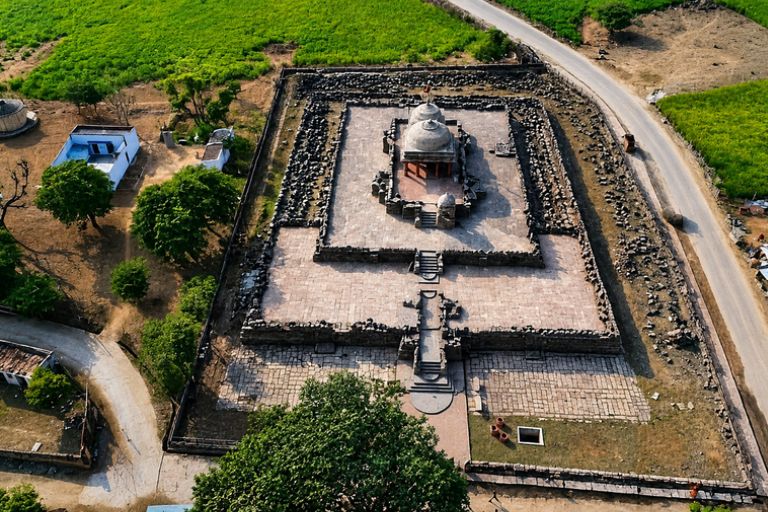
Harshat Mata Temple, Abhaneri
Navigate to any section — history, architecture, timings, or travel tips — all in one comprehensive guide.
About Abhaneri Village — The Historic Home of Harshat Mata Temple
History & Origin of Harshat Mata Temple, Abhaneri
Who Is Harshat Mata? The Goddess of Joy and Happiness
Architecture of Harshat Mata Temple — Gurjara-Pratihara Craftsmanship
Chand Baori and Harshat Mata Temple — The Sacred Connection
Visiting Harshat Mata Temple — What to Expect
Harshat Mata Temple Timings, Entry Fee & Visitor Information
Festivals & Religious Events at Harshat Mata Temple
How to Reach Harshat Mata Temple, Abhaneri
Nearby Places to Visit Around Harshat Mata Temple
Practical Travel Tips for Visiting Harshat Mata Temple
FAQs About Harshat Mata Temple, Abhaneri
Jai Mata Di 🙏
We bring you here the complete guide to Harshat Mata Temple, Abhaneri — one of the oldest and most spiritually significant temples in Rajasthan.
Situated in the historic village of Abhaneri in Dausa district, Rajasthan, the Harshat Mata Temple stands quietly beside the world-famous Chand Baori stepwell. While most visitors come to Abhaneri for the extraordinary geometry of Chand Baori, many are surprised to discover that just across the narrow stone pathway stands a temple that is even older, deeper in history, and equally remarkable.
Harshat Mata Temple is dedicated to Harshat Mata — the Goddess of Joy, Happiness, and Divine Energy. Built during the glorious Gurjara-Pratihara period in the 8th–9th century CE, the temple once represented some of the finest temple architecture in northern India. Even today, despite centuries of invasions, destruction, and weathering, its carved pillars, sculptures, and sacred atmosphere continue to leave visitors speechless.
The Harshat Mata Temple is famous for:
- Its connection with the legendary Chand Baori
- Magnificent Gurjara-Pratihara architecture
- Intricate stone carvings and ancient sculptures
- Spiritual significance as a Shakti temple
- One of the oldest surviving temple sites in Dausa district
- The fascinating legend of Goddess Harshat Mata
Unlike many crowded pilgrimage destinations, Harshat Mata Temple feels quiet, timeless, and deeply atmospheric. Standing on its elevated stone platform, surrounded by the silence of Abhaneri village, it feels less like a monument and more like a forgotten chapter of ancient India still waiting to be understood.
Now let us explore the complete story of Harshat Mata Temple — its history, architecture, mythology, spiritual significance, Chand Baori connection, timings, travel information, and everything else you should know before visiting.
Temple at a Glance
Complete quick-reference information about Harshat Mata Temple, Abhaneri — for devotees, researchers, and travellers.
| Temple Identity | ||
| 🏷️ | Official Name | Harshat Mata Ka Mandir (Harṣat Mātā kā Mandir) |
| 📝 | Also Known As | Harshad Mata Temple Harshat Mata Mandir |
| 📍 | Location | Abhaneri Village (also written Abaneri), Nangal Rajawatan Tehsil, Dausa District, Rajasthan |
| Deity & Worship | ||
| 🙏 | Primary Deity | Goddess Harshat Mata — Goddess of Joy and Happiness |
| 🪔 | Current Idol | Goddess Lakshmi — worshipped as Harshat Mata |
| ✨ | Deity Type | Shakti — Form of Goddess Durga / Devi |
| History & Architecture | ||
| 👑 | Dynasty | Gurjara-Pratihara — with possible Nikumbha / Chahamana association |
| 🏗️ | Built By | King Chanda of the Nikumbha dynasty — believed |
| 📅 | Period of Construction | 8th–9th Century CE — c. 800–825 CE per art historian Michael W. Meister |
| 🏛️ | Architectural Style | Mahameru / Nagara Style Panchayatana Plan |
| 🔖 | ASI Protected | Yes — ASI Protected Act No. LXXI of 1951 · dated 28 November 1951 |
| 🛕 | Temple Status | Active Place of Worship — partially in ruins |
| 🪜 | Adjacent Site | Chand Baori Stepwell — directly opposite |
| How to Reach — Distances | ||
| 🚗 | Distance from Jaipur | ~95 km — approx. 2 hours by road |
| 🚗 | Distance from Dausa City | ~35 km |
| 🚆 | Distance from Bandikui Jn. | ~8 km — nearest railway station · 15–20 mins by auto |
| ✈️ | Nearest Airport | Jaipur International Airport — ~90 km |
| Visitor Information | ||
| 🕰️ | Visiting Hours | 6:00 AM – 6:00 PM All Days |
| 🎟️ | Entry Fee | Free Entry — photography may have a nominal charge |
| 🌤️ | Best Time to Visit | October to March |
| 🎉 | Annual Festival | Abhaneri Festival — October · organized by Rajasthan Tourism |
| 👗 | Dress Code | Modest attire recommended — active religious site |
About Abhaneri Village — The Historic Home of Harshat Mata Temple
Before exploring the history and architecture of the Harshat Mata Temple, it is essential to learn about the village in which this ancient monument is located.
Abhaneri, also written as Abaneri, is a historic village situated in the Dausa district of Rajasthan along the Jaipur–Agra highway, nearly 95 km from Jaipur. Today, the village looks peaceful and modest, with narrow streets, traditional houses, small local markets, and agricultural fields surrounding its famous heritage sites. However, many centuries ago, Abhaneri was considered one of the most important cultural and architectural centers of eastern Rajasthan.
The village was originally known as Abha Nagari, which translates to “City of Brightness” or “City of Splendour.” Historians believe this name symbolized the prosperity, artistic richness, and spiritual significance the region possessed during the early medieval era.
From the 8th to the 10th century CE, Abhaneri prospered under the rule of the Gurjara-Pratihara dynasty, one of the most influential dynasties in northern India. During this period, grand temples, stepwells, and religious monuments were constructed throughout Rajasthan, and Abhaneri developed into a major center for temple architecture, commerce, and religious devotion.
Archaeological findings from the area further highlight the historical value of the village. Excavations have revealed ancient sculptures, Jain relics, and red-grey slipware pottery linked to early medieval Rajasthan. Many beautifully carved statues and temple remains discovered in Abhaneri are now preserved in museums located in Jaipur, Amber, and Delhi.
At the heart of this once-thriving settlement stood two remarkable structures that still define Abhaneri today — the renowned Chand Baori stepwell and the ancient Harshat Mata Temple. These monuments were closely connected both spiritually and architecturally. While the stepwell provided water and served travelers and pilgrims, the temple functioned as the spiritual center of the village.
Even after more than a thousand years, these monuments continue to stand beside each other, serving as enduring symbols of the glory, heritage, and resiliance of one of Rajasthan’s most remarkable historic villages.
According to records from the Archaeological Survey of India , Harshat Mata Temple dates back to the 9th century CE.
History & Origin of Harshat Mata Temple, Abhaneri
The Harshat Mata Temple in Abhaneri is believed to have been built during the 8th–9th century CE, making it one of the oldest surviving temples in Dausa district, Rajasthan. Most historians date the temple to around 800–825 CE after studying its architectural style, stone carvings, and sculptural patterns. Art historian Michael W. Meister of the University of Pennsylvania also associated the temple with this period based on its design and craftsmanship.
The temple is widely believed to have been commissioned by King Chanda of the Nikumbha Rajput dynasty — the same ruler associated with the construction of the famous Chand Baori stepwell located directly opposite the temple. Although no surviving inscription confirms this completely, historians strongly connect both monuments because of their similar time period, architectural planning, and spiritual relationship.
During this era, Abhaneri was an important cultural and religous center under the influence of the Gurjara-Pratihara dynasty. Rajasthan during this period witnessed remarkable temple construction, artistic innovation, and the growth of sacred architecture across northern India.
One of the most fascinating aspects of Harshat Mata Temple is the debate about its original identity. Today, the temple is dedicated to Harshat Mata, worshipped as a form of Shakti and the Goddess of Joy and Happiness. However, several scholars believe the temple may originally have been associated with Vaishnavism because sculptures of Vishnu, Garuda, and Balarama were discovered on the temple walls and surrounding structures.
Other historians strongly argue that the temple was always a Shakta shrine. Large fragments of Durga sculptures found near Chand Baori suggest that the original presiding deity may have been Goddess Durga in her Mahishasura-Mardini form. Over centuries, the temple evolved into the Harshat Mata shrine worshipped by devotees today.
Like many ancient temples of northern India, Harshat Mata Temple also faced destruction during medieval invasions. Historians believe the temple suffered major damage during the invasions linked to Mahmud Ghazni in the 10th–11th century. The magnificent shikhara tower was destroyed, sculptures were broken, and several parts of the original panchayatana temple complex disappeared over time.
Despite centuries of destruction, abandonment, and weathering, local devotion toward the goddess never fully ended. Villagers continued worshipping here, and portions of the temple were rebuilt using surviving stones and pillars. Many broken sculptures and temple fragments preserved around Chand Baori today still belong to the original temple complex.
The Archaeological Survey of India (ASI) later declared the site a protected monument and continues preservation efforts even today. Yet beyond its history and architecture, the most remarkable thing about Harshat Mata Temple is its uninterrupted faith. For more than 1,200 years, devotees have continued climbing these ancient stone steps to seek blessings from the Goddess of Happiness — a traditon that still survives in modern Rajasthan.
Who Is Harshat Mata? The Goddess of Joy and Happiness
The name tells you everything. Harshat comes from the Sanskrit Harsha — which means joy, delight, happiness, bliss. Harshat Mata is the Mother of Joy. She is a form of Shakti — the divine feminine energy — worshipped here as the bringer of happiness, prosperity, and well-being to all who come with faith.
An old legend in Abhaneri says that the goddess would light up the entire village with her radiant smile every evening. That after the evening prayers, she herself would light the lamps of the surrounding areas — going from home to home, from lane to lane — spreading her light and her joy across the village.
Whether you take this literally or as metaphor, the meaning is the same: Harshat Mata was not a distant or fearsome deity. She was, and is, a presence felt close to daily life. A mother who smiled. A goddess whose very nature was to give happiness.
For the people of Abhaneri and the surrounding region, she has been exactly that for over a thousand years.
The current idol in the sanctum is Goddess Lakshmi, worshipped as Harshat Mata after the original Durga idol was stolen in the 20th century. The goddess is protected on all sides by an iron boundary installed by the Archaeological Survey of India — and while the iron bars make it difficult to see her clearly, local devotees say that is not the point. The faith you carry in your heart is what matters. And that has never needed a clear view.
Architecture of Harshat Mata Temple — Gurjara-Pratihara Craftsmanship
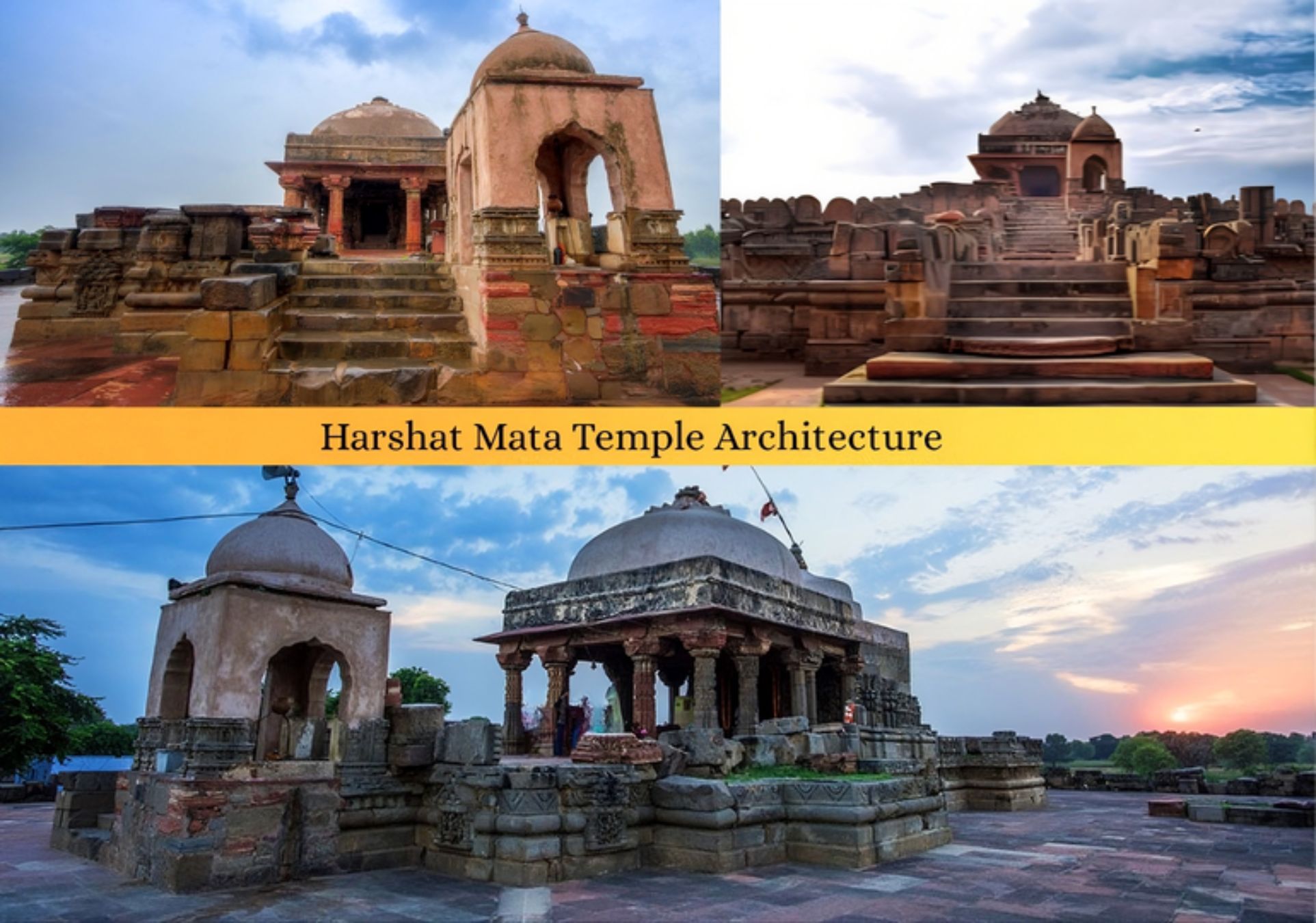
Harshat Mata Temple is one of the finest surviving examples of early medieval temple architecture in all of Rajasthan
Built in the Panchayatana style with a Mahameru / Nagara superstructure, the temple’s surviving mandapa pillars and sculptural carvings are described by art historians as among the finest post-Gupta sculptures in western India — stone that still pulses with life.
Even in its partially ruined condition, the Harshat Mata Temple remains one of the finest examples of early medieval temple architecture in Rajasthan. The carvings, pillars, sculpted panels, and surviving stone structures still reflect the extraordinary artistic brilliance of the 8th–9th century Gurjara-Pratihara period. What survives today is impressive enough — and what has been lost makes it easy to imagine how magnificent the temple once looked in its complete form.
The Original Panchayatana Temple Plan
The original Harshat Mata Temple was constructed in the Panchayatana style, a classical north Indian temple layout in which a main central shrine is surrounded by four smaller subsidiary shrines at each corner of the platform. This design created a balanced sacred geometry and was commonly used for important temple complexes during the early medieval era.
Today, only the central shrine survives, though in a partially rebuilt form. The four corner shrines were destroyed long ago, but careful visitors can still notice fragments of their original foundations around the temple platform.
The Lost Shikhara and Mahameru Design
The temple originally followed the Mahameru style of Nagara temple architecture, meaning it once possessed a tall and richly decorated shikhara (temple tower) rising prominently above the village skyline. Like many grand temples of medieval northern India, the tower was designed to be visible from a great distance, symbolizing divine presence and spiritual authority.
Unfortunately, the original shikhara was destroyed during medieval invasions. The dome visible today was added during later reconstruction efforts and is far simpler than the original structure. However, the surviving platform, carved walls, and mandapa still provide a glimpse into the temple’s former grandeur.
The Mandapa and Carved Pillars
One of the most remarkable surviving parts of Harshat Mata Temple is its mandapa, or pillared hall. The stone pillars are beautifully carved with floral motifs, divine figures, dancers, musicians, celestial women, and decorative patterns that demonstrate the exceptional skill of 9th-century artisans.
Art historians often describe these carvings as among the finest examples of post-Gupta sculpture in western India. The sculptures do not appear rigid or lifeless — they seem dynamic and full of movement. The apsaras (celestial women), gandharvas, dancers, and musicians carved into the stone still appear almost alive, giving the temple a sense of energy even after more than 1,200 years.
Sculptures and Surviving Stone Art
Visitors exploring the temple complex can still spot several important sculptural figures and fragments, including:
- Vishnu with Garuda
- Balarama carved in deep relief
- Apsaras in dance and musical poses
- Agni, the fire god
- Vyala (mythical lion-like creature)
- Gandharvas and heavenly beings
- Dancers and secular scenes from medieval life
- Shiva-like seated male figures
Many original sculptures from the temple were later moved for protection and preservation. Today, important pieces from Harshat Mata Temple can be found in:
- Government Museum, Amber
- Albert Hall Museum, Jaipur
- Hawa Mahal City Palace Museum
- National Museum, New Delhi
- ASI protected collections
Several carved stones and broken fragments visible near Chand Baori also originally belonged to the temple complex and were preserved there by the Archaeological Survey of India.
East-Facing Temple and Sacred Layout
Like many ancient Shakti and Shaiva temples, Harshat Mata Temple faces east toward the rising sun. The temple stands on elevated stepped terraces known as jagati, and visitors still climb these stone steps before reaching the sanctum area.
The original complex also included a pradakshina path for ritual circumambulation around the temple, though much of it is now damaged. Between the temple and Chand Baori stands a small Hanuman temple added in later centuries, while another small Shiva shrine within the complex adds a Shaivite dimension to this sacred site.
Even in ruin, the architecture of Harshat Mata Temple continues to feel alive. The carvings, stone textures, and sacred geometry still carry the artistic pulse of a civilization that once transformed Abhaneri into one of the great religous and architectural centers of medieval Rajasthan.
Chand Baori and Harshat Mata Temple — The Sacred Connection
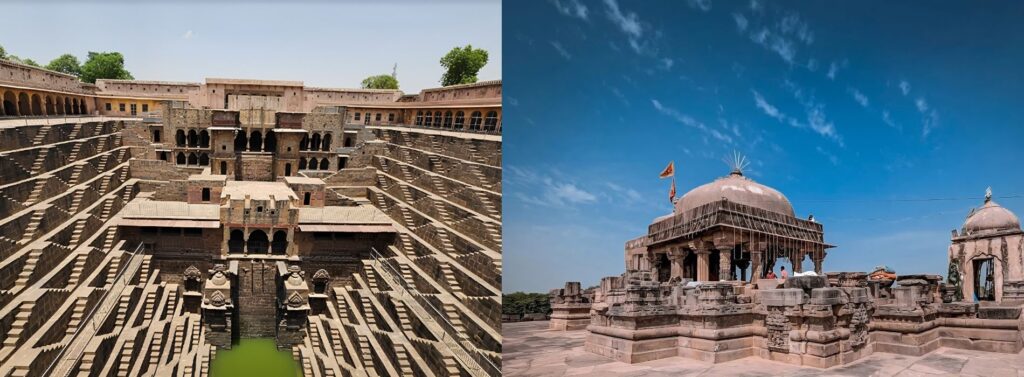
Chand Baori and
Harshat Mata Temple
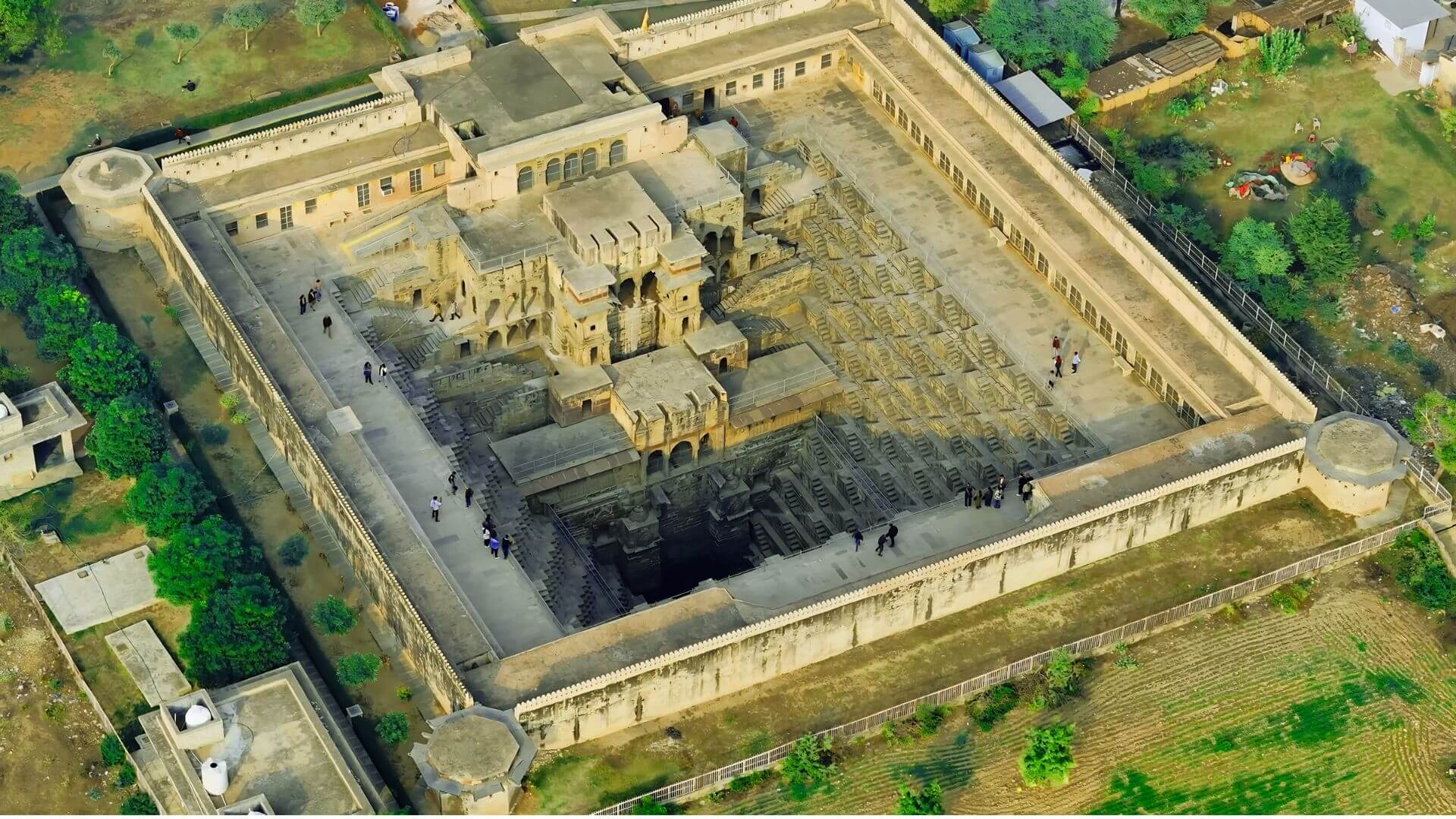
Chand Baori is one of the largest, deepest, and most architecturally extraordinary stepwells in all of India.
Built by King Chanda in the 8th–9th century CE, Chand Baori and Harshat Mata Temple were conceived as a single sacred complex — not two separate monuments. Pilgrims would first descend into the stepwell to purify themselves before crossing the lane for darshan at the goddess temple.
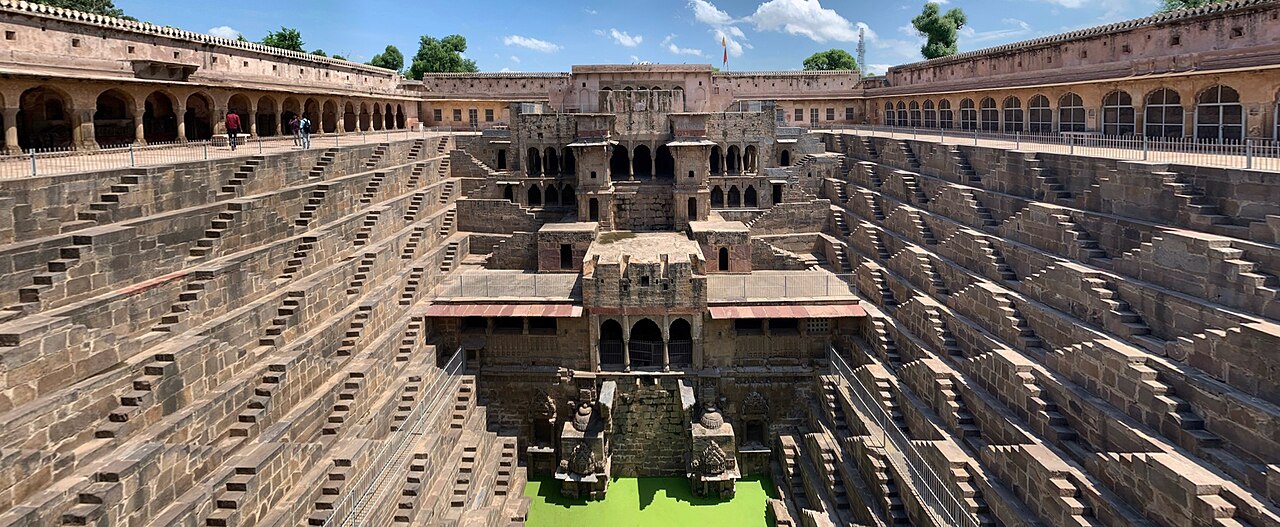
For additional historical and tourism information about Chand Baori and Harshat Mata Temple, visitors may also refer to the official Rajasthan Tourism page .
Visiting Harshat Mata Temple — What to Expect
Let me walk you through what visiting Harshat Mata Temple actually looks and feels like.
You arrive at Abhaneri village. If you have come from Jaipur, the drive has taken about two hours on the Jaipur–Agra highway, with a turn off at Sikandra or Bandikui. The village is small and unhurried. The road leading to the sites is narrow.
You will almost certainly see Chand Baori first — it’s immediately visible and unmistakable. After you have stood at its edge and processed the sheer impossibility of what human hands built here in the 9th century, you turn around.
There, across the lane, is the temple.
It sits on a raised stone platform — you have to climb a few steps to reach the entrnce level. The entrance faces east, and if you visit in the morning, the light falls beautifully across the carved stone. On either side of the entrance stairway are the low, ruined bases of two small subsidiary shrines.
As you enter the courtyard, you immediately notice the stones. Carved pillars and sculpture fragments are everywhere — some in neat rows, some lying at angles, all placed there by the ASI. Look at them closely. Even in fragments, the quality of the carving is extraordinary. The apsaras, the mythological scenes, the decorative borders — these are not mass-produced temple sculptures. They were made by artists.
The mandapa’s pillars are the most impressive surviving structural element — tall, intricately carved, and still largely intact. The outer walls carry their bhadra niches, most empty now but still beautifully framed.
At the center stands the main sanctum with its rebuilt dome. The idol of the goddess — Lakshmi, worshipped as Harshat Mata — is inside, protectd by an iron boundary. You may not be able to see her clearly through the iron bars. But you can offer a prayer. And local devotees, for whom the question of visibility never mattered, will be doing exactly that beside you.
To the side, you will find the small Shiva shrine — also in active use.
The whole experience — temple, courtyard, scattered sculptures, surrounding quiet — takes about 45 minutes to an hour if you are genuinely paying attention. Combined with Chand Baori, plan two to three hours total at Abhaneri.
Then sit somewhre in the courtyard for a moment before leaving. Look at the carved stones. Think about the hands that made them — a thousand, two hundred years ago. Think about what the temple looked like when its shikhara was whole and its walls were covered with what you are now seeing only in fragments.
That quiet thinking is, perhaps, the most worthwhile thing you can do here.
Harshat Mata Temple Timings, Entry Fee & Visitor Information
Harshat Mata Temple Timings & Entry Details
| 🌅 | Opening Time | 8:00 AM |
| 🌇 | Closing Time | 6:00 PM |
| 📅 | Open On | All Days of the Week |
| 🎟️ | Entry Fee — Temple | Free Entry |
| 🪜 | Entry Fee — Chand Baori |
Indian
₹ 20
Foreigner
₹ 250
— may check with ASI
|
| 📸 | Photography | Permitted at Chand Baori Restricted inside Sanctum |
| 👗 | Dress Code | Modest attire recommended — active religious site |
| 🅿️ | Parking | Available near the site — informal parking area |
| 🌤️ | Best Time to Visit | October to March |
Festivals & Religious Events at Harshat Mata Temple
The Abhaneri Festival — October Every Year
The most significant annual event at Abhaneri is not a traditional religious festival but something unique: the Abhaneri Festival, organized by the Rajasthan Tourism Department since 2008. This two-day festival, held every October at Abhaneri (near Dausa), celebrates the living cultural heritage of Rajasthan through its finest folk traditions. Visitors from across India and around the world come to witness:
- Ghoomar — the iconic circular dance of Rajasthani women
- Kalbeliya — the serpentine folk dance of the Sapera community
- Kachhi Ghodi — the dramatic mock-horse dance
- Langa and Manganiyar — traditional Rajasthani folk music
- Raas Leela — devotional dance drama
- Bhawai — the acrobatic folk dance balancing pots on the head
- Puppet shows and art & craft exhibitions
The setting — right at the steps of Chand Baori, with Harshat Mata Temple visible in the background — makes this one of the most atmospheric folk festivals in Rajasthan. The Abhaneri Festival has grown considerably in reputation over the years and is now considered a highlight of Rajasthan’s cultural calendar.
If you can time your visit to Abhaneri for October, this festival is an experience unlike anything else.
Navratri
Both the Chaitra and Sharada Navratris are observed with devotion at Harshat Mata Temple. As a Shakti shrine, Navratri is the most sacred period of the year for the goddess. Special prayers, decorations, and increased devotee visits mark both occasions.
How to Reach Harshat Mata Temple, Abhaneri and Chand Baori
Useful Location Links
📍 View Harshat Mata Temple location on Google Maps
📍 View Chand Baori location on Google Maps
How to Reach Harshat Mata Temple, Abhaneri & Chand Baori
Abhaneri village is located on the Jaipur–Agra highway (NH-21), making it accessible from multiple directions. That said, it is not the kind of destination with great public transport connections — hiring a vehicle is usually the most practical approach.
By Air
Nearest AirportThe nearest airport is Jaipur International Airport (Sanganer), approximately 90–95 km from Abhaneri.
Pre-book a taxi from the airport for the most comfortable journey. The drive takes approximately 2 hours.
By Train
Nearest Railway StationBandikui Junction is the nearest railway station — just 8 km from Abhaneri. Several trains on the Jaipur–Agra rail route stop here.
From Bandikui station, you can take:
- Auto-rickshaw — most commonly available
- Local taxi or shared vehicle to Abhaneri (~15–20 minutes)
Dausa Railway Station is another option at approximately 35 km, with good road connections.
By Road
Most Popular RouteThe most popular and convenient way to reach Abhaneri. Take the Jaipur–Agra highway (NH-21) eastbound.
- From Jaipur: After passing Sikandra, watch for the Abhaneri turn-off — a short drive off the main highway
- Budget option: Jaipur → Sikandra (bus) → Abhaneri (shared jeep or auto) — less convenient
- Note: No direct RSRTC bus runs from Jaipur to Abhaneri currently
| From | Distance | Travel Time |
|---|---|---|
|
Jaipur
|
~95 km | 1.5 – 2 hours |
|
Delhi
|
~230 km | 4.5 – 5 hours |
|
Agra
|
~180 km | 3 – 3.5 hours |
|
Dausa City
|
~35 km | 45 minutes |
|
Bandikui
|
~8 km | 15 – 20 minutes |
|
Mehandipur Balaji
|
~20 km | 30 – 40 minutes |
If you are visiting from Jaipur, Abhaneri and Mehandipur Balaji Temple (about 20 km apart) can be combined into a single day trip. This is one of the most rewarding day-trip routes from Jaipur — start at Mehandipur for morning darshan, then head to Abhaneri for the afternoon.
Nearby Places to Visit Around Harshat Mata Temple
Mehandipur Balaji Temple (~20 km)
One of India’s most powerful Hanuman temples — for pilgrims and spiritual seekers, this is essential. The energy here is unlike anything else in Rajasthan. Easily combined with Abhaneri in a single day. [→ Mehandipur Balaji Temple — Full Guide]
Bhangarh Fort (~55 km)
One of India’s most famous “haunted” forts, set dramatically in the Aravalli hills. Fascinating for history and architecture lovers, and the stories are almost impossible to resist.
Sariska Tiger Reserve (~70 km)
A full wildlife sanctuary with Bengal tigers, leopards, and rich birdlife. A natural extension for visitors combining heritage, spirituality, and wildlife experiance in one journey.
Jaipur — The Pink City (~95 km)
Govind Dev Ji Temple, Birla Mandir, Galtaji, Amber Fort, City Palace — Jaipur is the natural base for exploring this entire region of Rajasthan. [→ Explore Temples in Jaipur District]
Neelkanth Mahadev Temple, Dausa (~45 km)
A peaceful Shiva temple known for its calm and meditative atmosphere — a quiet contrast to the intensity of Mehandipur Balaji. [→ Neelkanth Mahadev Temple — Full Guide]
Kaila Devi Temple, Karauli (~110 km)
One of the most revered Shakti temples in Rajasthan, Kaila Devi Temple attracts lakhs of devotees every year, especially during the famous Kaila Devi fair. The spirutual atmosphere here feels powerful yet deeply devotional. [→ Kaila Devi Temple Karauli — Full Guide]
Practical Travel Tips for Visiting Harshat Mata Temple
Things that will genuinely make your visit smoother:
- Hire a private vehicle from Jaipur. Public transport to Abhaneri is limited and the connections are inconvenient. A private cab for the day gives you flexibility to combine Abhaneri with nearby sites
- Visit in the morning. The light on carved stone in the morning hours is extraordinary — particularly for photography (at Chand Baori where photography is permitted)
- Wear comfortable walking shoes. Both the temple (stone steps and uneven courtyard) and Chand Baori (many levels) require stable footwear
- Remove footwear before entering the temple sanctum. This is a religious space — follow the customs of all Hindu temples
- Dress modestly. As an active temple, respectful attire is expected inside
- Photography inside the temple sanctum may be restricted — observe the rules and ask if unclear. At Chand Baori, photography is generally permitted with a nominal charge
- Carry water. Abhaneri is a small village with limited facilities. Bring water and snacks for the visit
- Allow 2–3 hours minimum to do justice to both Chand Baori and the temple together. Rushing through either is a disservice to what they are
- Come during October if possible — the Abhaneri Festival (organized by Rajasthan Tourism) makes this visit extraordinary
- October–March is ideal for weather. April–June is very hot in eastern Rajasthan — if you must visit, go early morning and leave before midday
FAQs
❓ FAQs About Harshat Mata Temple, Abhaneri
Visit More Temples in Dausa District
Harshat Mata Temple is one of many sacred and heritage sites in Dausa. Continue your spiritual and cultural journey through Rajasthan’s historic temples.
Temples in Dausa District
Browse the complete directory of sacred temples, heritage shrines, and spiritual places across Dausa district.
Mehandipur Balaji Temple
Visit the world-famous Balaji temple dedicated to Lord Hanuman and spiritual healing traditions.
Neelkanth Mahadev Temple
Discover the sacred Shiva temple known for its peaceful atmosphere and spiritual importance in Dausa.
Somnath Mahadev Temple
Explore another revered Mahadev temple associated with local faith, devotion, and Rajasthan heritage.
Paplaj Mata Temple
Learn about the famous Mata temple in Lalsot, known for regional devotion and spiritual traditions.
Temples in Rajasthan
Explore temple destinations, pilgrimage sites, and ancient spiritual heritage across Rajasthan.
A Few Words About Harshat Mata Temple Abhaneri
There is a particular kind of feeling that ancient places give you, and it is quite different from what modern ones give.
Modern places impress you. Ancient places humble you.
Standing in the courtyard of Harshat Mata Temple Abhaneri — looking at carved stones that were made a thousand two hundred years ago, with the skill of artists whose names nobody remembers — you feel the full weight of how long humans have been trying to make beautiful things in honour of something they believed in.
Go and find her. She is not hard to reach.
And when you are standing in that courtyard, with the carved stones around you and Chand Baori’s impossible geometry visible across the lane, let yourself slow down for a moment.
That moment is the visit.
Jai Mata Di 🙏
This article is part of IndiaMandir’s dedicated temple guide series for Dausa District, Rajasthan. Information is regularly updated based on research and visitor inputs. If you have visited Harshat Mata Temple and have information, photographs, or stories to share, we would love to hear from you.
Explore Nearby Temples
Discover famous temples and sacred heritage places around Harshat Mata Temple, Abhaneri