
Chand Baori, Abhaneri — Complete Guide to Rajasthan’s Most Mysterious Stepwell
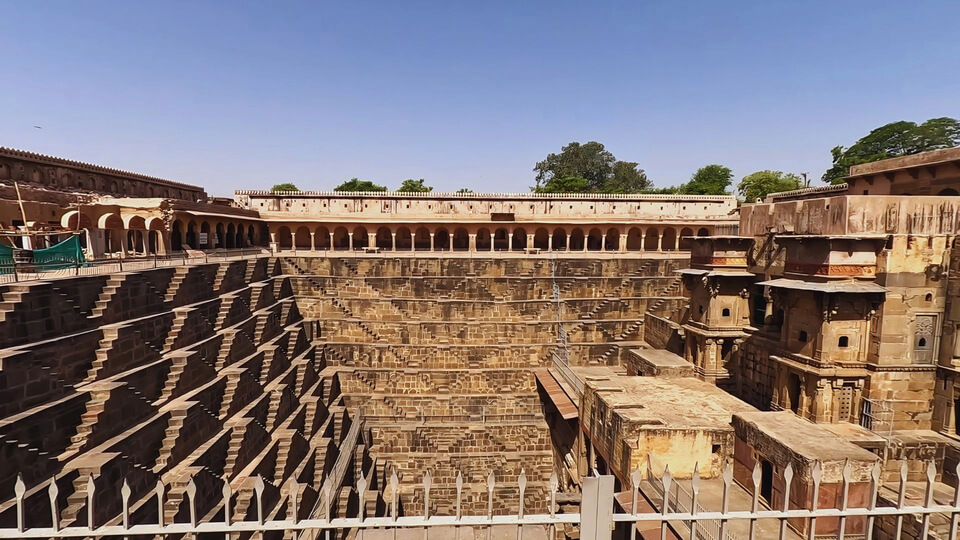
Chand Baori, Abhaneri Complete Guide to India’s Most Mysterious Stepwell
Chand Baori in Abhaneri, Rajasthan — one of India’s deepest and most mysterious stepwells. Learn its history, architecture, legends, timings, ticket details, connection with Harshat Mata Temple, and complete travel guide before visiting.
Chand Baori cannot be separated from the ancient Harshat Mata Temple complex. Before exploring this magnificent stepwell, readers should understand the spiritual and historical importance of the temple connected to it.
Explore Harshat Mata Temple →Located directly opposite the Harshat Mata Temple in Dausa district, Chand Baori, Abhaneri is considered one of the deepest and most architecturally extraordinary stepwells in India. Built during the 8th–9th century CE, the stepwell is widely associated with King Chanda (or Chandra) of the Nikumbha dynasty, from whom the structure is believed to derive its name.
At first glance, Chand Baori feels almost unreal. The massive geometric design descends deep into the earth through thousands of perfectly symmetrical stone steps. From above, the entire structure resembles a giant inverted pyramid carved with mathematical precision.
It is impossible to truly understand Harshat Mata Temple without first understanding Chand Baori. These two monuments were never meant to exist separately. They were designed together, worshipped together, and for more than 1,200 years, they have continued to stand facing each other in the historic village of Abhaneri, Rajasthan.
Architecture and Design of Chand Baori
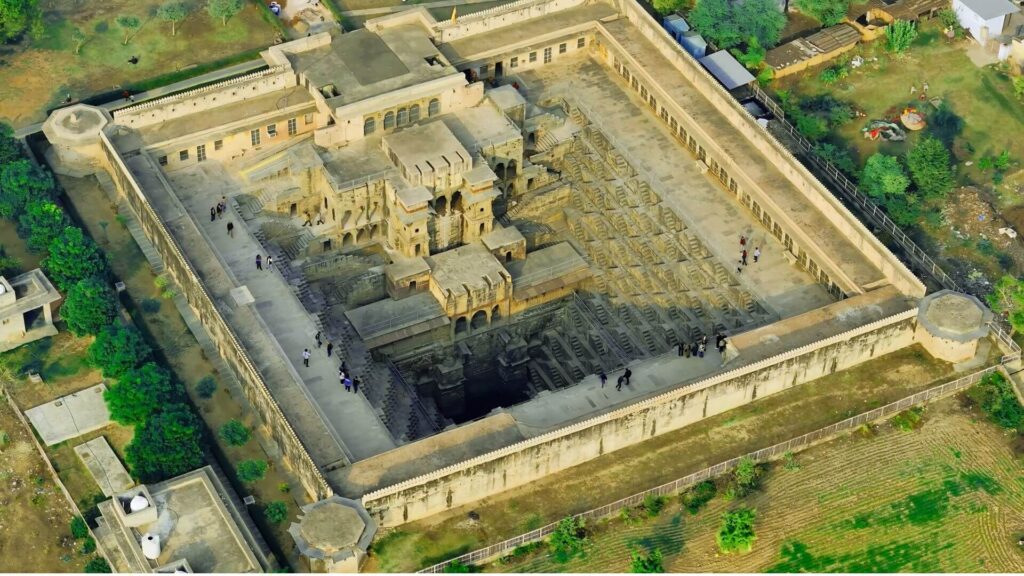
Chand Baori is approximately 100 feet deep and extends through 13 storeys into the ground. Across three sides of the well are nearly 3,500 narrow stone steps arranged in a mesmerizing symmetrical pattern. The deeper levels remain significantly cooler than the surface, making the stepwell not only a water reservoir but also a natural cooling space during Rajasthan’s intense summer heat.
The baori was constructed using large sandstone blocks joined carefully with iron clamps — an advanced engineering technique for its time. Historians and local guides often point out that lime mortar was minimally used in the earliest construction phases, highlighting the remarkable stone craftsmanship of early medieval Rajasthan.
One side of the stepwell features a multi-level royal pavilion and resting chambers where rulers and royal guests once gathered. Local traditions also speak of dance performances, cultural gatherings, and ceremonial events held here centuries ago. Hidden chambers, corridors, and underground tunnels associated with the structure continue to fuel fascination and mystery even today.
The Ritual Connection Between Chand Baori and Harshat Mata Temple
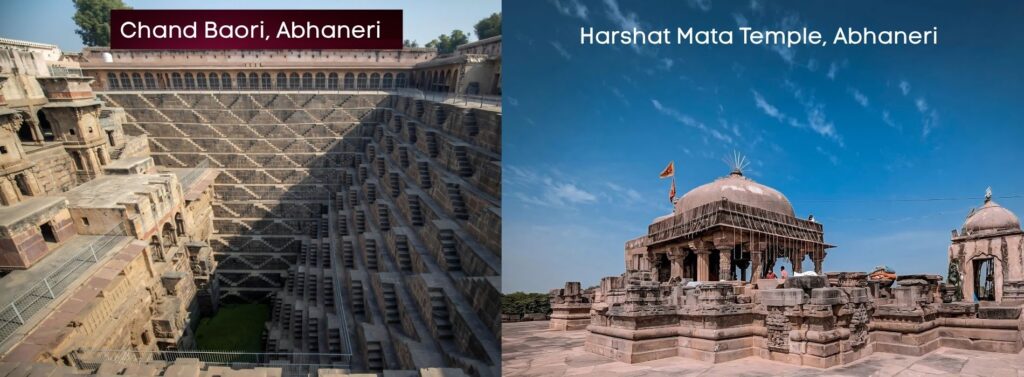
What many visitors do not realize is that Chand Baori was not merely a water structure. It was an essential part of the Harshat Mata Temple complex itself.
In ancient times, pilgrims visiting Abhaneri would first descend into the baori to wash their hands and feet before proceeding to the temple for darshan. Water purification before worship was an important ritual practice, making Chand Baori the spiritual gateway to Harshat Mata Temple.
According to local stories, hidden passages once connected parts of the royal pavilion and temple area. Some legends claim the royal family used these tunnels during emergencies, while others believe they were used for private movement between the temple and palace structures.
For Detailed Images may visit Chand Baori website
Legends and Mysteries of Chand Baori, Abhaneri
Like many ancient Indian monuments, Chand Baori, Abhaneri is surrounded by legends. One of the most famous local beliefs says that the stepwell was built overnight by spirits or supernatural beings because ordinary humans could never create something so geometrically perfect.
Standing at the top and looking down into the endless criss-crossing staircases, the story suddenly does not feel impossible.
Another popular belief says that a person descending the baori could never return using the exact same staircase because of the structure’s highly symmetrical design. This maze-like appearance is one reason Chand Baori is sometimes called a “bhool bhulaiyaa” of steps.
During full moon nights, locals say the reflection of moonlight on the water once illuminated the entire baori, creating a glowing silver appearance that further strengthened its mystical identity.
Sculptures and Artistic Heritage of Chand Baori, Abhaneri
The walls and surrounding galleries of Chand Baori contain several carved niches and sculptural fragments depicting Hindu deities including Ganesha, Mahishasura-Mardini, Vishnu, and other divine figures. Many broken sculptures preserved around the site originally belonged to the nearby Harshat Mata Temple complex.
Even today, the carvings visible around the baori showcase the artistic brilliance of Gurjara-Pratihara craftsmanship and reveal how deeply religion, water architecture, and daily life were interconnected in medieval Rajasthan.
Chand Baori, Abhaneri in Films and Popular Culture
Because of its dramatic appearance, Chand Baori, Abhaneri has become one of the most photographed and filmed heritage sites in India. The stepwell gained international attention after inspiring the design of “The Pit” in Christopher Nolan’s The Dark Knight Rises.
It has also appeared in several Bollywood and international productions, including:
- Paheli
- Bhool Bhulaiyaa
- The Fall
- Bhoomi
Following these appearances, Chand Baori became increasingly popular among international travelers, photographers, filmmakers, and architecture enthusiasts visiting Rajasthan.
Visiting Chand Baori Today
Today, Chand Baori and Harshat Mata Temple remain the heart of Abhaneri village. Visitors usually explore both monuments together, as they are separated only by a narrow pathway.
While photographs capture the symmetry and scale of Chand Baori, the actual experience feels very different in person. The silence, depth, stone textures, and geometric perfection create an atmosphere that is difficult to describe — somewhere between architecture, history, spirituality, and mystery.
Even after more than twelve centuries, Chand Baori continues to stand not merely as a stepwell, but as one of India’s greatest surviving examples of sacred engineering and artistic imagination.
Chand Baori Ticket Price, Timings & Practical Travel Tips
Before visiting Chand Baori and Harshat Mata Temple, a few practical details are worth knowing.
Chand Baori Timings
Chand Baori is open daily from 8:00 AM to 6:00 PM, including weekends and public holidays. Morning hours between 8:00 and 11:00 AM are ideal for photography, as the soft sunlight brings out the geometric patterns of the steps. Late afternoon, roughly 4:00 to 6:00 PM, offers cooler temperatures and thinner crowds.
Entry Ticket Price
Entry fees are ₹25 for Indian visitors and ₹300 for foreign visitors. Still photography is generally permitted without charge, but professional DSLR or video shooting may require separate permission from the Archaeological Survey of India. Harshat Mata Temple, located right next to the stepwell, carries no separate entry fee.
Since ASI ticket prices are occasionally revised, it is always worth confirming the current rates before travelling.
Best Time to Visit
The ideal season to visit is October to March, when the weather across Jaipur and the surrounding region remains pleasant. Summers from April to June can be extremely hot, while the monsoon months of July to September may make the stone steps slippery.
Practical Tips for Visitors
- Visit Harshat Mata Temple and Chand Baori together — they stand directly opposite each other within the same complex.
- Set aside at least two to three hours to properly explore both sites.
- Carry drinking water, particularly between April and June.
- Wear comfortable, closed footwear — the stone pathways and surrounding areas can be uneven.
- Early morning remains the best time for photography and for avoiding tourist groups.
- Maintain respectful behaviour inside the temple premises and avoid loud noise in the sacred areas.
- The roads to Abhaneri via the Jaipur–Agra Highway (NH21), turning off at Sikandra, are smooth and well-marked. Abhaneri makes an excellent half-day heritage stop for those travelling between Jaipur and Agra.
- Mobile connectivity and small food stalls are available nearby, but facilities remain limited compared to major heritage cities in Rajasthan.
Important Visitor Note
Visitors are generally not permitted to descend fully to the lower levels of Chand Baori, due to safety and heritage preservation requirements. Most viewing and photography takes place from the upper galleries and designated areas. Even from above, the sheer scale and geometric precision of the stepwell — with 3,500 steps arranged across 13 stories — remains extraordinary.
Since 2008, the Rajasthan Tourism Department has also organised the two-day Abhaneri Festival every October at the nearby village of Dausa, featuring Rajasthani folk performances including Ghoomar, Kalbeliya, and Kachhi Ghodi, along with puppet shows and craft exhibitions. Visitors timing their trip in October may coincide with this festival for an even richer experience.
Chand Baori, Abhaneri – FAQs
Chand Baori was built in the 8th or 9th century CE by King Chanda of the Nikumbha dynasty. It was designed to solve water scarcity in Rajasthan and became a major community gathering place.
The entry fee is ₹25 for Indian visitors and ₹300 for foreign tourists. Children below 14 years can enter free of charge.
Chand Baori is one of the world’s deepest and largest stepwells, featuring around 3,500 perfectly symmetrical steps across 13 levels.
No. Visitors are restricted from entering the lower levels for safety and preservation reasons.
Originally, it stored rainwater and provided a cool resting place during Rajasthan’s intense summers.
Chand Baori has approximately 3,500 narrow steps descending about 30 metres deep.
Chand Baori remains open daily from 8:00 AM to 6:00 PM.
October to March is considered the best season due to pleasant weather and excellent photography conditions.
Chand Baori is located around 95 km from Jaipur and takes nearly 2 hours by road.
Absolutely. Its ancient engineering, geometric beauty, and rich history make it one of Rajasthan’s most unique attractions.
Continue Your Spiritual Journey
Explore more sacred places, ancient temples, and spiritual heritage sites across Dausa and Rajasthan.